Why Bangkok Is Full of Hindu Gods, Monkey Armies and One Very Large Swing
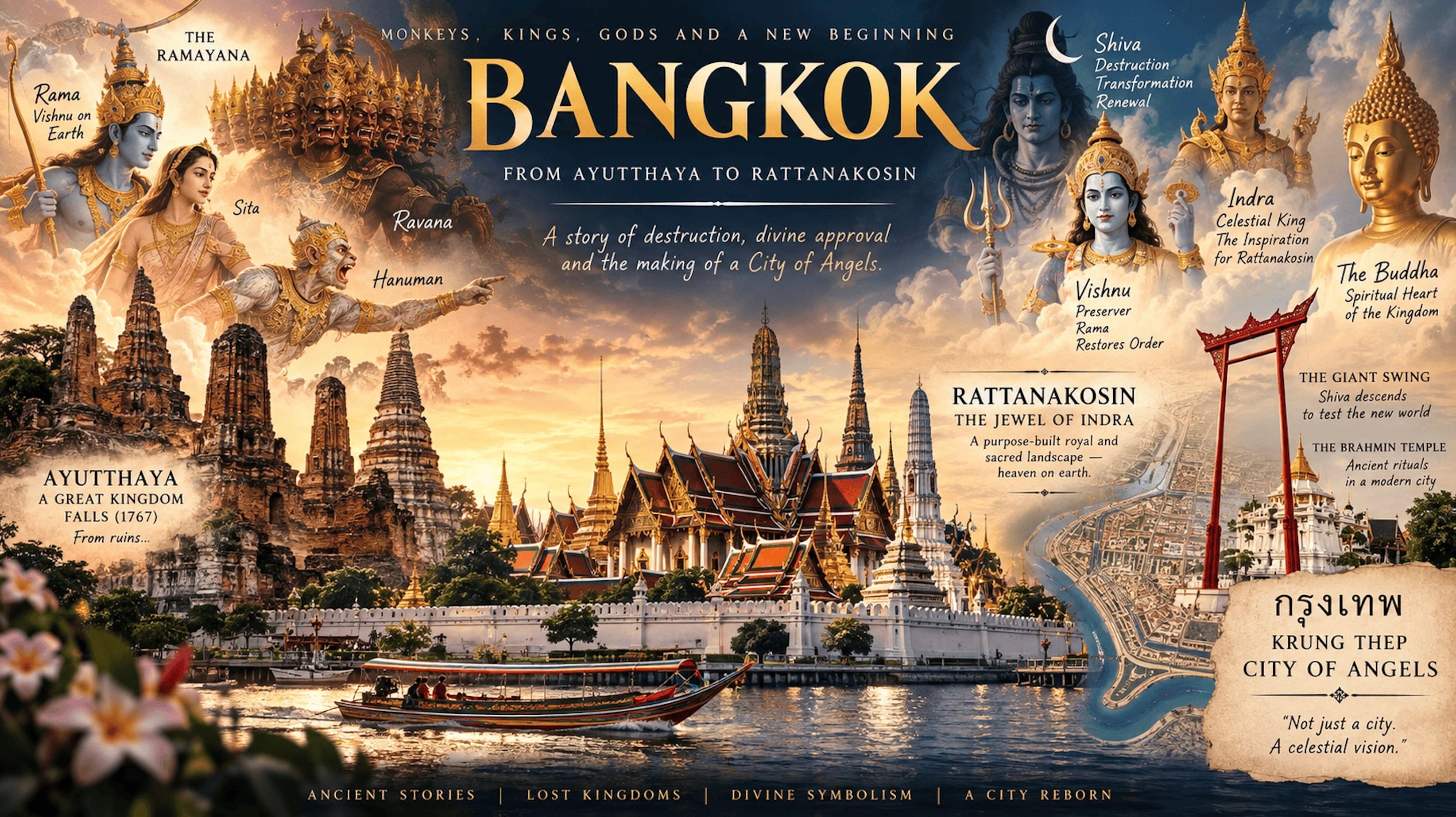
Before Bangkok makes sense, you need to know about Rama.
The story of Rama is told in the Hindu epic, the Ramayana and is told in shadow puppets, dances etc throughout time all through India and Asia.
Think King Arthur and the Sword in the Stone - and you touch the surface of this epic.
But there's so much more than a lady of a lake and Sir Lancealot.
Rama is the one with the kidnapped wife, the ten-headed demon and a monkey general who routinely solves problems by setting things on fire.
The Ramayana is one of the great Indian epics, and at its simplest it’s a cracking rescue story. Rama is the rightful prince of Ayodhya, but thanks to some spectacularly effective family politics, he’s banished for fourteen years.
His wife Sita follows him into exile, where she is kidnapped by Ravana, the immensely powerful demon king of Lanka.
Rama goes after her. Along the way he teams up with Hanuman, commander of a monkey army and arguably the most entertaining character in Asian mythology.
They find Sita, invade Lanka, kill Ravana and eventually Rama returns home to take his rightful place as king.
So far, so Hollywood - or Bollywood.
Except Rama isn’t simply a prince.
He’s Vishnu in human form.
Why Vishnu Needed a Day Job
Vishnu is the Hindu god responsible for preserving cosmic order. When things on Earth get sufficiently out of hand, he occasionally comes down personally to straighten things out.
Ravana qualifies.
He has acquired enormous supernatural powers and then made the traditional mistake of powerful men everywhere: assuming this means the normal rules no longer apply to him.
So Vishnu is born into the human world as Rama.
And that gives the Ramayana another meaning beneath all the demons, battles, monkeys and marital difficulties.
It’s a story about dharma — duty, justice and the proper order of things.
Rama is the rightful king but loses his kingdom. Ravana is a king who possesses enormous power but abuses it.
Eventually Ravana falls, Rama returns to his throne and the proper order of the world is restored.
Remember that bit.
Because now we’re going to Thailand and if you come to Thailand with us you get to see where the rubber meets the road in this ongoing epic saga . . .
Ayutthaya: Named After Rama’s City
The Ramayana didn’t arrive in Thailand with tourism.
The great Siamese capital Ayutthaya — อยุธยา — takes its name from Ayodhya, the legendary city of Rama.
The Siamese also developed their own magnificent version of the Ramayana, the Ramakien.
Rama became Phra Ram. Sita became Nang Sida. Ravana became the ten-headed Thotsakan.
Hanuman remained Hanuman, because nobody looked at Hanuman and thought, this character needs work.
For more than 400 years, Siamese kings ruled from a capital whose very name connected them with the legendary city of the ideal king.
Then, in 1767, the Burmese arrived and absolutely flattened it.
When we walk around Ayutthaya, those magnificent ruined temples aren’t picturesque ruins created for Instagram. They’re the remains of one of Asia’s great cities after a catastrophic war.
The capital fell. The court was scattered. Temples and palaces were destroyed. Manuscripts and records disappeared.
The old order had quite literally collapsed.
Which creates a very Ramayana-like question:
Who restores order after the kingdom falls apart?
Enter Thongduang
After Ayutthaya’s destruction, King Taksin reunited much of Siam and established his capital at Thonburi.
One of his leading generals was Thongduang.
Following the dramatic collapse of Taksin’s reign in 1782, Thongduang became king and founded a new dynasty.
We know him today as Rama I.
And there was an awkward little detail.
He wasn’t the straightforward hereditary successor to the old Ayutthayan throne.
He had military power. He had political power.
What he now needed was legitimacy.
So Rama I did something far more ambitious than building himself a nice palace.
He set about rebuilding the Siamese universe.
Welcome to Rattanakosin
Rama I moved the capital from Thonburi to the opposite bank of the Chao Phraya.
And when we’re walking around old Bangkok, this is the city he created.
The Chao Phraya River protects one side. Canals were dug around the others, effectively creating a fortified royal island.
That’s: เกาะรัตนโกสินทร์ — Ko Rattanakosin.
Rattanakosin Island.
We still pass sections of the old fortifications. Once you understand the geography, you can actually see Rama I’s plan: river, canals, walls, forts, royal city safely inside.
But the name is the really lovely bit.
- Rattana = jewel, gem, something precious.
- Kosin = a literary name for Indra.
So Rattanakosin is approximately:
The Jewel of Indra.
And Indra isn’t just some Hindu god Rama I pulled randomly from the celestial phone book.
In Thailand he’s Phra In — พระอินทร์.
Buddhism had incorporated Indra as Sakka, ruler of Tāvatiṃsa heaven — essentially the celestial king.
So our new earthly king establishes a new royal capital wrapped in the imagery of the king of heaven.
The branding department had clearly been called in.
Now Put the Emerald Buddha in the Middle
In 1784, Rama I installed the Emerald Buddha at Wat Phra Kaew, beside his new Grand Palace.
And the Emerald Buddha wasn’t simply a particularly nice Buddha image.
It was effectively a palladium — a sacred object whose possession was associated with the legitimacy, protection and prosperity of a kingdom.
It had already been associated with several powerful Southeast Asian centres before the Siamese acquired it.
Now Rama I places it at the spiritual heart of his new capital.
So we have:
- new king
- inside a new royal city
- called the Jewel of Indra
- with one of Southeast Asia’s most sacred Buddha images sitting at its centre.
You could accuse Rama I of many things, but underselling the launch wasn’t one of them.
And then he surrounds the Emerald Buddha with something fascinating.
The Ramakien

Around the galleries of Wat Phra Kaew is the great Thai version of our story.
Rama. Sita. Thotsakan. Hanuman. Demons. Monkey armies. Battles. Flying things. Magic weapons . . . and enough gold leaf to bankrupt a small country.
It’s tempting to look at these murals as incredibly elaborate decoration.
But remember the story they’re telling.
- A rightful king loses his kingdom.
- Chaos follows.
- The righteous king fights back.
- The forces of disorder are defeated.
- The king returns.
- Order is restored.
And what’s sitting inside those walls?
The sacred Buddha image protecting the new kingdom Rama I has just established after the destruction of Ayutthaya.
Nobody actually wrote underneath the murals:
RAMA I WOULD LIKE TO STRESS THAT ANY SIMILARITY TO RECENT EVENTS IS PURELY COINCIDENTAL.
They didn’t really need to.
We shouldn’t push the analogy too far — the Ramayana had been part of Siamese kingship for centuries before Rama I.
But as political symbolism goes, it’s magnificent.
So Why Are There Hindu Gods All Over Buddhist Bangkok?
This is where Bangkok becomes much more interesting.
Thailand didn’t simply choose Buddhism and throw all the Hindu gods in the bin.
It incorporated them.
The Buddha represents the ultimate spiritual authority.
Indra becomes the celestial king within the Buddhist universe.
Vishnu gives us Rama — the model of righteous earthly kingship.
But when you build a new world or even a human king's model of a new world you need to get building approvals.
Enter SHIVA and the Giant Swing . . . and building approvals
For Shiva, we leave the Emerald Buddha, wander through Rattanakosin and find an enormous red structure that looks as though someone started building a children’s playground and accidentally received a government infrastructure budget.
But first, who is Shiva and why is he here?
If Vishnu is the great preserver of cosmic order . . . the god who comes to Earth as Rama when things need sorting out . . . Shiva has the rather more dramatic portfolio of destruction and transformation.
That sounds sinister, but Shiva isn’t the bad guy. In Hindu thought, destruction is necessary for renewal. Old worlds end so new ones can begin.
Things are created, preserved, destroyed and created again.
Which makes Shiva a remarkably appropriate god to encounter in a city built after the catastrophic destruction of Ayutthaya.
The Giant Swing was part of an ancient Brahmanical ceremony centred on Shiva. Its Thai name, Triyampavai, derives from the Tamil Tiruvempāvai, devotional hymns to Shiva.
And the mythology behind the ceremony is wonderfully appropriate.
Shiva descends to Earth to test whether the newly created world is stable.
The swinging ritual symbolically recreated this cosmic test — essentially checking that the mountains, waters and earth weren’t going to start moving about once the gods had signed off on construction.
Now think about Rama I.
His old world — Ayutthaya — has been destroyed.
He’s established a new dynasty, moved the capital, dug canals, built defensive walls and forts, constructed a palace and temples and begun rebuilding the religious and political order of Siam.
And among the ancient royal ceremonies he restores is one in which Shiva, the god of destruction, transformation and renewal, comes down to inspect the stability of a newly created world.
You really couldn’t script it much better.
Rama I has just finished rebuilding the Siamese universe after its spectacular demolition in 1767.
And now Shiva turns up to check the workmanship.
RATTANAKOSIN — INSPECTED BY SHIVA. BUILDING APPROVAL GRANTED.
The Giant Swing

The Giant Swing — Sao Chingcha — was established by Rama I in 1784.
Yes, the same year the Emerald Buddha was installed.
And Yes, about the exact same year as the new capital was formed . . . so it is very important and not put there by accident.
Beside it is the Devasathan, the Brahmin temple. Thailand still has a tradition of royal Brahmin priests who participate in important royal ceremonies.
The swing is no longer in use because part of the swing ceremony involved men standing on a swinging platform and propelling themselves high into the air, attempting to grab a bag of coins from a pole with their teeth.
People occasionally died.
Eventually the authorities concluded that perhaps Shiva could be welcomed to Bangkok without killing quite so many people, and the swinging part was abandoned.
The enormous red frame remains.
And suddenly our food walk past the Giant Swing isn’t just passing an odd Bangkok landmark.
We’re walking through part of the ritual machinery of Rama I the firsts new capital.
Now Put the Whole Thing Together
Within a remarkably small area of old Bangkok we have:
- Rattanakosin — the Jewel of Indra, the celestial king.
- The Grand Palace — home of the earthly king.
- The Emerald Buddha — sacred protector and symbol of the Buddhist kingdom.
- The Ramakien — Vishnu incarnated as Rama, the righteous king who defeats chaos and restores order.
- The Brahmin Temple — maintaining ancient Hindu-derived royal rituals.
- The Giant Swing — ceremonially welcoming Shiva into the earthly realm and getting his seal of approval.
And surrounding everything: river, canals, walls and forts, physically separating the royal city from the world outside.
That’s why Rattanakosin is much more interesting than simply calling it “Bangkok Old Town".
It is the Jewel of Indra.
A purpose-built royal and sacred landscape, protected by river, canals, walls and forts, with the Grand Palace and Emerald Buddha at its heart.
Rama I wasn’t simply building a new capital after the destruction of Ayutthaya. Symbolically, he was rebuilding the universe.
The Buddha sits at its spiritual centre. Indra is the celestial king. Vishnu descends as Rama to restore order. Shiva arrives to make sure the new world is stable. The Brahmins perform the ancient ceremonies. And in the middle of all this sits the earthly king.
In other words, Rama I had created something approaching heaven on Earth.
Which finally makes Bangkok’s Thai name rather less mysterious.
Thais don’t normally call their city Bangkok. They call it:
กรุงเทพ — Krung Thep
Krung = city Thep = deity, celestial being or angel
Hence the familiar translation:
CITY OF ANGELS
So when we walk through Rattanakosin, we’re not just wandering around the oldest part of Bangkok.
We’re walking through Rama I’s vision of a celestial city on Earth — the Jewel of Indra, protected by the Buddha, populated symbolically by gods and celestial beings, and ruled from its centre by the king.
“City of Angels” suddenly doesn’t sound like a tourism slogan. It sounds like the entire bloody point.
And that’s the trick to understanding old Bangkok
Once you know this, Rattanakosin stops being simply “the old bit of Bangkok with the palace in it.”
Rama I was building much more than a defensible capital.
After the destruction of Ayutthaya, he was reconstructing an entire idea of how the world should work . . . a heaven on earth.
- The Buddha sits at its spiritual centre.
- The Emerald Buddha protects the kingdom.
- Indra provides an image of celestial kingship.
- Vishnu descends as Rama, the ideal righteous ruler.
- Brahmins maintain ancient royal rituals.
- Shiva occasionally drops in near the Giant Swing.
- And the king rules from the middle of it all.
So when we visit Ayutthaya first, we’re looking at the world that was lost.
When we later walk through Rattanakosin, we’re walking through Rama I’s attempt to put that world back together.
And when you see those hundreds of colourful Ramakien characters fighting their way around the walls of Wat Phra Kaew, don’t dismiss them as decoration.
They’re telling you what the whole place is about:
Chaos happens. Kingdoms fall. The righteous king restores order.
For a former general who had just become king, founded a dynasty and rebuilt Siam after the destruction of a capital literally named after Rama’s own city, it was an exceptionally handy story to have painted on the walls.